S&P Global Ratings cut Queensland’s long-term issuer credit rating from AA+ to AA on Friday 11 September, the state’s first downgrade since 2009. The agency affirmed the short-term A-1+ rating and assigned a stable outlook.
S&P had told Queensland it may need to downgrade well before the May 2026 budget, and Treasurer David Janetzki told reporters on Thursday 10 September that one was expected. Federal Treasurer Jim Chalmers called the prospect “very troubling”.
“The stable outlook on the long-term rating reflects our view that Queensland’s budgetary performance will remain weak over the next few years as the state ramps up its infrastructure spending, resulting in debt being structurally higher than in the past,” S&P said.
Why the Rating Fell
S&P pointed to “persistent inflation, rising interest rates, higher wages, and softening property market sentiment”, which it said would “likely weigh on Queensland’s budgetary outcomes and fiscal recovery over the next two to three years”.
The state’s spending programme is dominated by preparations for the 2032 Brisbane Olympics and Paralympics. The agency said weaker management could drive “persistent operating deficits and wider deficits after capital accounts, and substantially higher debt”, and that an upgrade would be possible if Queensland narrowed deficits and ran more operating surpluses.
The Numbers
Debt is listed at nearly $200 billion in the latest budget and is projected to reach $216.4 billion by 2029. Interest costs are forecast to double from $3.3 billion this financial year to $7.7 billion just before the Olympic Games begin.
The June budget forecast a $6.2 billion deficit in 2026/27, and no surplus is expected until 2029-30.
Mr Janetzki says federal changes to negative gearing and capital gains tax cooled the housing market, cutting stamp duty revenue by $223 million in the first two months of the financial year, about $1 billion less revenue across 2026/27.
Mr Chalmers counters that Queensland received almost $20 billion in GST, up $2.6 billion, and that stamp duty is “up 58 per cent over the last couple of years”.
The Political Fight
Mr Janetzki said: “The Labor government’s fiscal vandalism has led us towards an inevitable credit rating downgrade.” After the downgrade was confirmed, he said: “You know, treasuries keep receipts, and I’ve got plenty of Labor receipts, and that is what we are facing here today.”
On the federal dispute, he said: “This morning Jim Chalmers called me a liar, and Jim Chalmers can call me names. I’m going to be calling out facts, and the facts are clear, and they are confirmed by S&P.”
Mr Chalmers told ABC Radio Brisbane: “The Queensland budget is not under pressure because of the Commonwealth, on the contrary.” He said Mr Janetzki “is lying when he says that the pressure on the state budget is because of the Commonwealth”.
Mr Chalmers said the agencies had been signalling a downgrade “at least 12 months, maybe 18 months, certainly well before the Commonwealth Budget”. He noted S&P and Moody’s had confirmed the Commonwealth budget at AAA in the weeks beforehand.
What It Costs
Economist Gene Tunny said: “It will have real consequences because what it means is that the cost of government borrowing will be higher.” He called it “a bit of an embarrassment” for a state “which was historically very well governed and very well managed”.
The extra borrowing cost lands on a budget already managing many of the pressures households face, including fuel prices and interest rates. Queensland Treasury Corporation said a downgrade had been anticipated “for some time” and was “largely incorporated” into market pricing.
What It Means for Queensland
The immediate effect is the cost of borrowing, which flows through to the budget bottom line. The longer test is the path back to surplus, which the June budget does not reach until 2029-30.
S&P says a further cut could follow weaker management, while narrower deficits and more operating surpluses would open the door to an upgrade.
On the same day, the same agency revised NSW’s AA+ outlook from negative to stable, which NSW Treasurer Daniel Mookhey called an endorsement of fiscal discipline.
A Moody’s decision on Queensland’s rating is still pending.
Sources: Queensland Government statement from the Treasurer regarding S&P Global Ratings, 11 September 2026, https://statements.qld.gov.au/statements/106043; Jim Chalmers, interview with Steve Austin, ABC Radio Brisbane, ministers.treasury.gov.au, https://ministers.treasury.gov.au/ministers/jim-chalmers-2022/transcripts/interview-steve-austin-brisbane-mornings-abc-radio-2; Nine.com.au, “Queensland’s credit rating downgraded for the first time since 2009”, https://www.nine.com.au/australia-news/qld/queensland-credit-rating-downgraded-aa-debt-brisbane-olympics-20260911-p60wms.html; The Australian, “Queensland credit rating downgraded as Crisafulli turns blind eye to debt”, 11 September 2026; Investor Daily, “S&P downgrades Qld credit rating on Olympics spending”, https://www.investordaily.com.au/sp-downgrades-qld-credit-rating-on-olympics-spending/
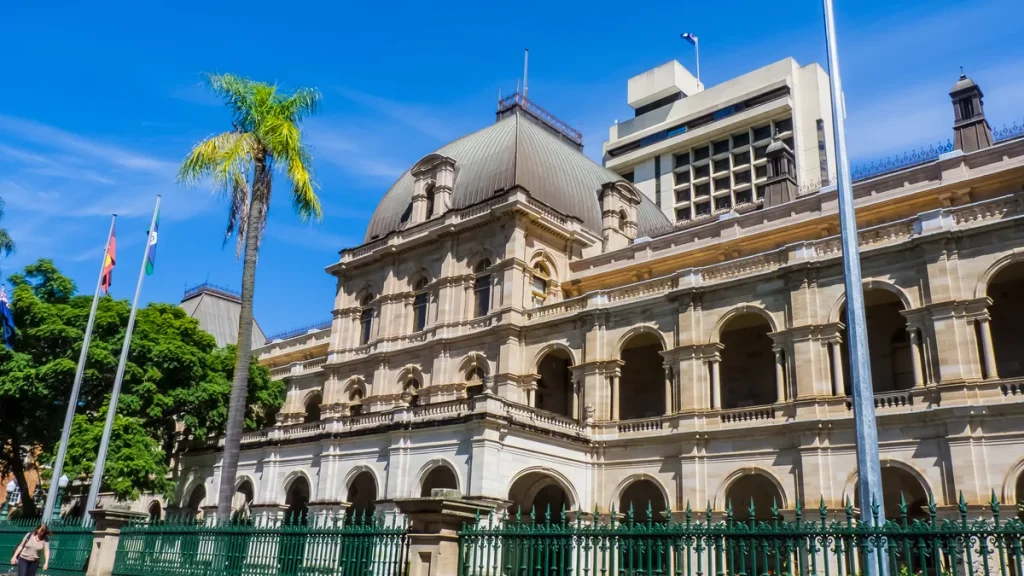
Photo: John Robert McPherson, CC BY-SA 4.0, via Wikimedia Commons.
Illustrative: Parliament House, Brisbane, photographed in 2011. S&P Global Ratings downgraded Queensland’s credit rating from AA+ to AA on 11 September 2026.