
Israelis vote on Tuesday 27 October in the country’s first general election since the Hamas-led attacks of 7 October 2023, with polling showing a tight race between Prime Minister Benjamin Netanyahu and former army chief Gadi Eisenkot, BBC News reported on 22 October.
ABC News says the election is effectively shaping up as a referendum on Netanyahu’s leadership.
The Contenders
Eisenkot was chief of staff of the Israel Defense Forces from 2015 to 2019 and formed his Yashar party in September 2025, according to ABC News.
He lost his son, a soldier, early in the Gaza war, and served in the war cabinet until resigning in 2024, the BBC reported.
Netanyahu has framed himself as “Mr Security”, according to the BBC. Donald Trump has formally endorsed him for another term, ABC News reported.
Another former IDF chief, Benny Gantz, dropped out of the race on 19 October, according to the ABC.
The Road to 61 Seats
Thirty-eight parties are contesting the election for the 120-seat Knesset, and a majority is 61 seats, according to ABC News.
Excluding right-wing media, most polling suggests Yashar will be the largest party with 20 to 23 seats and Likud second on 19 to 21, according to the ABC’s summary of the polls as at 23 October.
On the same summary, the right-wing “Netanyahu bloc” reaches 49 to 51 seats, and the opposition parties likely to back Eisenkot reach 52 to 55. Roughly 14 to 19 seats fall to smaller groups, including the Palestinian parties.
Neither bloc reaches 61 without groups such as The United Arab List or The Joint List, the ABC reported. On those figures, any government will need partners.
All but one of the leading Jewish parties have ruled out working with the Arab parties, the BBC reported. About one-fifth of Israel’s population is Arab, according to the BBC.
The Issues
The main issues are security and accountability for the 7 October attacks, the conscription of ultra-Orthodox men, judicial reform and the cost of living, according to BBC News.
Opposition parties are campaigning for an independent national inquiry into 7 October, which Netanyahu has rejected, ABC News reported.
How the Vote Works
Voting is a single nationwide vote, with no electorates, according to the ABC. Voters pick a ballot carrying their party’s logo. There is no early voting, no overseas voting and no postal voting, except for soldiers.
Polls open at 7am local time on Tuesday 27 October, which is 4pm AEDT, and close at 10pm, which is 7am AEDT on Wednesday 28 October, the ABC reported.
Exit Polls, Then the Bargaining
Exit polls are published at 22:00 local time, according to BBC News. Preliminary results are expected the day after polling, and official results are scheduled for 4 November.
The count does not settle who governs. After consultations, President Isaac Herzog invites the leader he judges most likely to form a government, the BBC reported. That process can take more than a month, and a failure to form a government can lead to new elections.
Israel held five elections between 2019 and 2022, according to the BBC.
More world news is in prw’s International archive.
Who is asked to form the next government will not be known until the results are in and the President’s consultations are complete.
Sources: ABC News, “Israelis are heading to the polls in their most seismic election in decades”, 23 October 2026 (https://www.abc.net.au/news/2026-10-23/israel-election-2026-explained/107287156); BBC News, “How do Israel’s elections work and who are the main contenders?”, 22 October 2026 (https://www.bbc.co.uk/news/articles/cx8dz75633vjo)
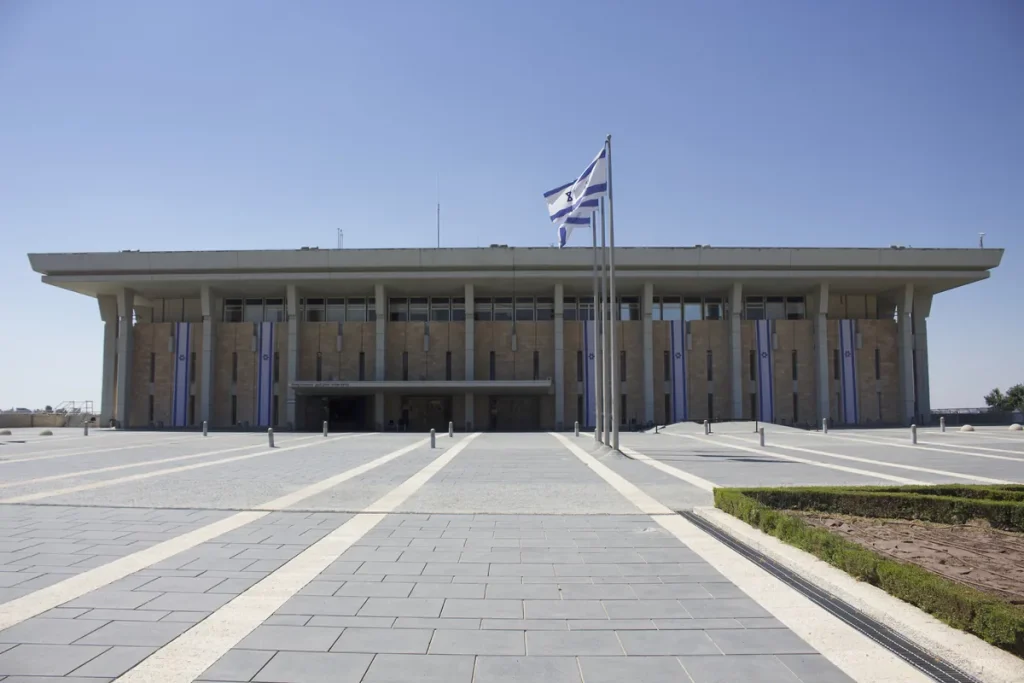
Photo: Clema12, CC BY-SA 4.0, via Wikimedia Commons.
The Knesset, Israel’s 120-seat parliament, in Jerusalem, photographed in July 2022.