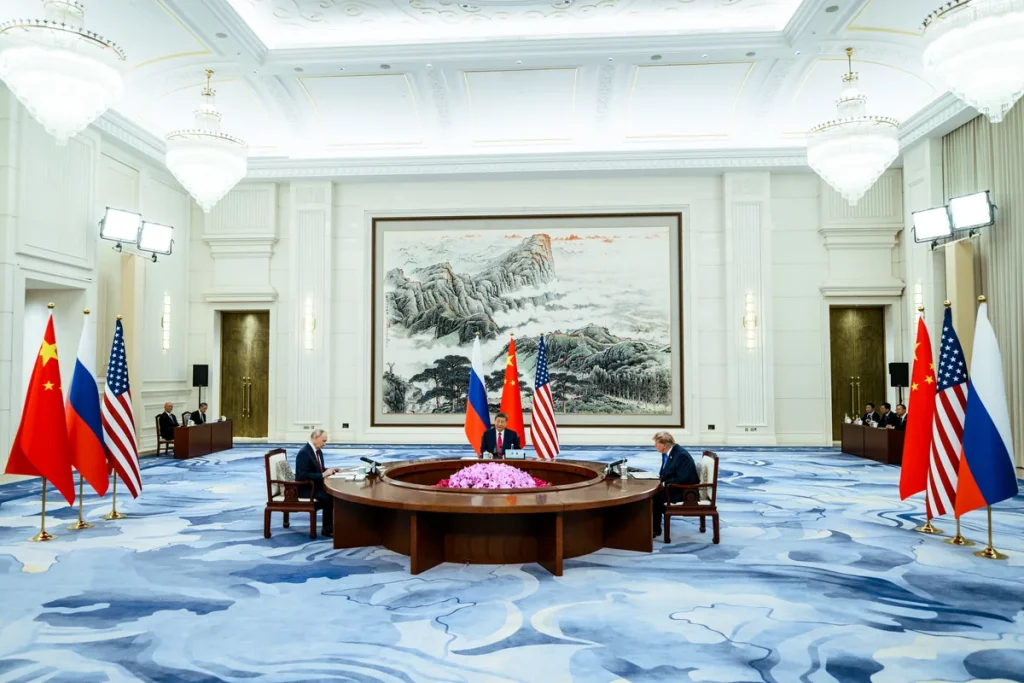
Donald Trump, Vladimir Putin and Xi Jinping issued a “joint declaration of peace” after their first three-way talks, held behind closed doors at the Kylin Villa in Shenzhen on Thursday 19 November, on the sidelines of the Asia-Pacific Economic Cooperation (APEC) summit, BBC News reported.
Xi hosted, The Sydney Morning Herald reported. The BBC and the Herald put the talks at about 90 minutes; The Guardian said about one hour and 20 minutes. prw’s preview of the meeting set out what each leader was expected to bring.
Will the three countries hold further talks on nuclear risk reduction?
Choose an answer, then select Vote.
Four Points
The Herald reported that China and Russia released a broadly worded four-point joint statement, which they said the three leaders had agreed.
On nuclear war, the Herald quoted the text as saying “a nuclear war cannot be won and must never be fought”, and the BBC reported the same line.
The BBC said the countries planned to increase the production and supply of petroleum, and that the leaders were “committed to reform the UN” so that it can respond more effectively to global challenges. The fourth point concerns the International Criminal Court: the BBC reported that the leaders agreed it and similar institutions “must not abuse their jurisdiction”, and that the immunity enjoyed by state officials was flagged. Putin is subject to an arrest warrant from the court, The Guardian reported.
What the Guardian Found Missing
The Guardian reported that the declaration made no mention of the wars in Ukraine and Iran, and did not point to the start of a framework for denuclearisation. It added that the nuclear-war wording matches language used in a statement by the five permanent members of the UN security council.
The Herald reported that, after 90 minutes of closed-door discussions, the leaders emerged with no major concrete commitments, including on arms control or the wars in Ukraine or Iran, and that it was not clear whether they would hold future trilateral discussions.
In the Room
“We are really making history,” and “No peace was ever forged by declining opportunities for engagement.” Trump said both before reporters left the room, The Guardian and the Herald reported.
Xi said, as the BBC reported, that “positive interaction among major powers is not a matter of choice, but a mandatory requirement”. The BBC reported that Putin highlighted a shared interest in ending the Ukraine war.
Ukraine and Iran
The BBC reported that Trump said he and Putin had held a “long discussion” on Ukraine in their separate meeting earlier on Thursday 19 November, their first since August 2025. Putin said Ukraine and Europe were not yet ready to make compromises, the BBC reported.
On the 1945 Yalta comparison, Putin said, according to the BBC: “Nobody divided up the world at Yalta. It simply codified the realities that had emerged after WW2.” He added: “And when it comes to today’s conflicts, the realities on the ground will have to be accepted.”
On Iran, the BBC reported Trump saying it was “vital” that the countries co-operate to “combat the threat of nuclear proliferation in other countries around the world”, and adding: “That’s what we’re doing in Iran.”
After the meeting, the Herald reported, Trump called into a meeting in Berlin of US envoys Jared Kushner and Steve Witkoff, Ukraine’s President Volodymyr Zelensky and more than 40 European leaders. Polish Prime Minister Donald Tusk said Trump’s message was “received very cautiously in the room”, the Herald reported.
Reaction
Putin called it an “important chapter in the history of diplomacy”, the BBC reported, and Xi described it as “positive, constructive, and highly productive”, according to CCTV as quoted by the BBC.
Republican Senator John Curtis, who sits on the Senate foreign relations committee, said in an emailed statement to the BBC that he was encouraged by the recognition that nuclear war must never be fought, but that “Vladimir Putin and Xi Jinping are not our friends”. The BBC added that Democratic Senator Jeanne Shaheen also criticised the warmth of the meeting.
“Overall, very little of substance seems to have been accomplished … This summit appears to have been all about the symbolism and prestige value,” said Prof William Hurst of the University of Cambridge, according to The Guardian. Putin pushed back at the suggestion that the summit was just a photo-op, the paper reported: “It is a serious collaborative work,” he said.
What the Wording Leaves Open
Two things were still to come as at the Herald’s update on 20 November. The US side had not released its own summary of the meeting, the Herald reported, and the BBC reported that Trump said he would hold a news conference at the White House on Friday 20 November.
“The real test will be whether the three countries follow through on their stated commitment to discuss nuclear risk reduction and preventing nuclear proliferation,” said Patricia Kim of the Brookings Institution, according to The Guardian.
More of prw’s coverage of world affairs sits in the International archive.
Sources: The Guardian, “China, Russia and US agree peace declaration with no mention of Ukraine and Iran wars”, 20 November 2026 (https://www.theguardian.com/world/2026/nov/19/china-russia-us-agree-peace-statement-no-mention-ukraine-iran-wars); BBC News, “Trump, Putin and Xi release ‘peace declaration’ after historic meeting”, 19 November 2026 (https://www.bbc.co.uk/news/articles/c623j4ln97x7o); The Sydney Morning Herald, “‘We are really making history’: Trump, Xi and Putin issue ‘peace’ declaration after rare summit”, 19 November 2026 (https://www.smh.com.au/world/asia/trump-putin-and-xi-talk-nuclear-weapons-and-ukraine-20261119-p61fsk.html)
Photo: Daniel Torok, The White House (official White House photograph), public domain, via Wikimedia Commons.
Vladimir Putin, Xi Jinping and Donald Trump at the round table in the Kylin Villa in Shenzhen during their trilateral talks on 19 November 2026.