
A team led by Patryk Sofia Lykawka of Kindai University in Japan, who is also an adjunct associate professor at the University of Southern Queensland, has proposed a hidden planet beyond Neptune, nicknamed Planet X2 (PX2), the Royal Astronomical Society (RAS) said on Monday 23 November.
It is not a discovery. The proposal rests on computer simulations spanning 4.5 billion years of Solar System history, and no telescope has seen the planet. The RAS said PX2 “remains hypothetical”. It is meant to explain the unusual orbits of some icy objects far beyond Neptune.
“Imagine discovering, after decades of mapping our Solar System, that another planet has been hiding from us all this time,” Lykawka said in the RAS release.
The paper, “Signatures of an Earth-class Planet in the Distant Solar System”, is published in Monthly Notices of the Royal Astronomical Society, according to the RAS release. Jonti Horner of the University of Southern Queensland is a co-author. ScienceAlert named a third researcher, Pedro Bernardinelli of the University of Washington.
Do you think there is another planet beyond Neptune?
Choose an answer, then select Vote.
What Is Being Proposed
The RAS measure is mass, not size: PX2 would be about 1.5 to 2 times Earth’s mass. The RAS gave its orbit as hundreds of times farther from the Sun than Earth’s, with a semi-major axis of around 350 to 500 astronomical units and a closest approach of at least 200 astronomical units. One astronomical unit is the average distance between Earth and the Sun, the RAS said.
It is a different idea from Planet Nine, which the RAS described as suggesting “a substantially more massive world”. Horner told ScienceAlert that the two ideas explain different orbital patterns, so the Solar System could hold neither, one or both.
“It is possible that there could be neither. It’s possible there could be both. It’s possible there could be one or the other,” he said.
Why Look Beyond Neptune
The RAS said Kuiper Belt objects mostly move in a broad disc between 38 and 50 times the Earth-Sun distance. Further out, objects such as Sedna follow unusually tilted or elongated orbits that the known planets struggle to explain. In the simulations, PX2’s gravity could influence how icy objects move, either separating them from Neptune’s influence or tilting their orbits, the RAS said.
ScienceAlert reported on Monday 23 November that the team compared simulations with only the four giant planets against simulations with an extra distant planet. The extra planet produced populations more like the observed tilted and detached orbits.
How Well the Model Fits
The fit is partial. “Our model reproduces several of the unusual orbital patterns observed among distant icy objects, although there are still differences between the model and observations that we need to investigate further,” Lykawka said in the RAS release.
ScienceAlert reported that the models reproduce several features of distant objects seen by the Dark Energy Survey, but the distribution of their semi-major axes “doesn’t quite match”. “This isn’t a perfect fit. You wouldn’t expect it to be. I’d be more worried if it was, to be honest,” Horner told ScienceAlert.
Lykawka told the ABC, in its report of Tuesday 24 November, that even at its closest approach the planet would be “tens of times fainter than Pluto”, and that wider ranges of sky would need to be observed. Jaime Alvarado Montes of Macquarie University, who was not involved in the work, called it a “very robust theoretical study”, the ABC reported.
What Rubin Could Settle
Horner said in the RAS release that the Vera C. Rubin Observatory’s Legacy Survey of Space and Time “could help researchers test predictions”. The ABC said Rubin surveys the southern sky from Chile to build a 10-year time-lapse record, and Horner told it Rubin could be the key.
ScienceAlert said Rubin could in principle spot the planet itself, though its distance and faintness would make that “a much tougher proposition”. Other researchers will test alternative explanations, Horner told ScienceAlert.
prw reported on Saturday 21 November on Voyager 1 reaching one light-day from Earth, and on Saturday 24 October on Australia’s final bid to fly Katherine Bennell-Pegg to the ISS. More space and technology coverage is in the Technology archive.
Sources: Royal Astronomical Society, “Could astronomers be closing in on a hidden planet beyond Neptune?”, 23 November 2026 (https://ras.ac.uk/news-and-press/research-highlights/could-astronomers-be-closing-hidden-planet-beyond-neptune); ABC News, “Hypothetical ninth planet could answer Solar System mysteries, new research suggests”, 24 November 2026 (https://www.abc.net.au/news/2026-11-24/qld-hypothetical-ninth-planet-research-modelling/107418880); ScienceAlert, “Astronomers Find Signs of a SECOND Earth-Like World in The Space Beyond Neptune”, 23 November 2026 (https://www.sciencealert.com/forget-planet-nine-hints-of-a-second-secret-world-emerge-from-the-edge-of-the-solar-system)
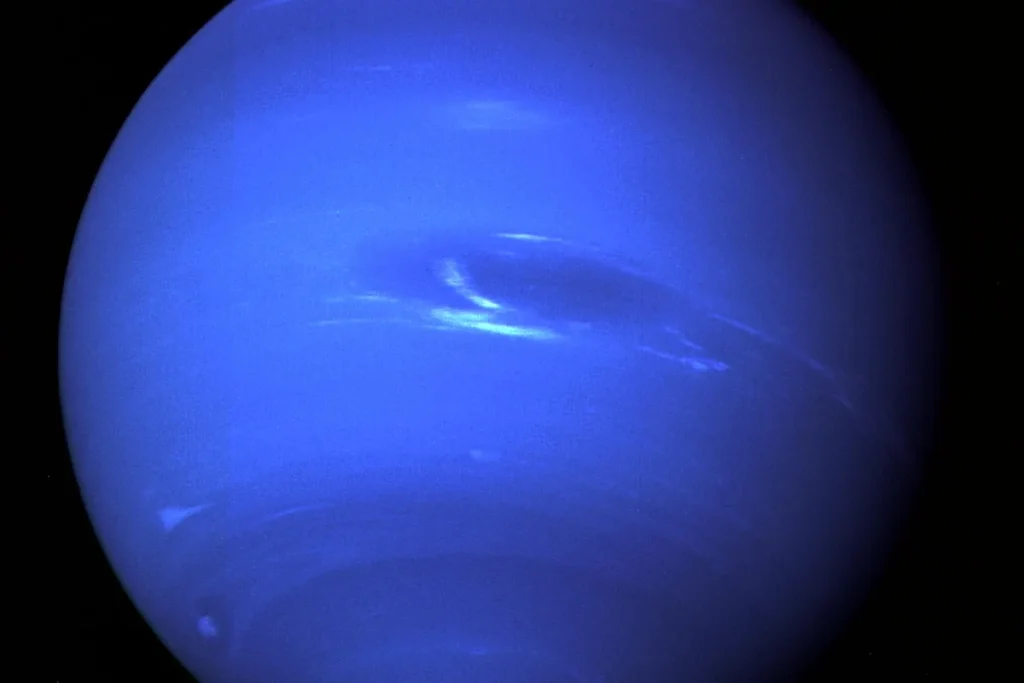
Image: NASA/JPL.
Neptune as Voyager 2 saw it in August 1989, in a picture from NASA’s Jet Propulsion Laboratory. The proposed Planet X2 would lie far beyond it and has not been seen.