Gabon’s media regulator, the High Communication Authority (HAC), has lifted the suspension of Facebook, TikTok, YouTube and Instagram that began on 17 February, ending an eight-month ban, BBC News reported. The HAC announced the U-turn in a televised statement on Saturday 24 October, according to the BBC.
Under the new terms, users are required to provide formal identification, which effectively ends online anonymity, Africanews reported. A regulation passed in February requires users to give verified names, addresses and ID numbers, according to Anadolu.
Should a government be able to switch off social media during unrest?
Choose an answer, then select Vote.
Talks With the Platforms
“The HAC has decided to lift the suspension of social media platforms,” HAC spokesman Jean Claude Mendome said, according to Anadolu.
Mendome said the suspension had aimed to “allow the government to adapt its legal framework to better regulate social media”, Anadolu reported. The decision to lift it followed direct talks with major international technology companies on improving moderation, according to the agency.
The authority said it was working with Meta, TikTok and YouTube to “improve content moderation”, Africanews reported.
According to Anadolu, the HAC also urged users to be “more responsible and mature in their online exchanges and behaviors, in order to contribute to a healthier, more constructive digital environment that is more respectful of the rights of others.”
Why the Gabon Social Media Ban Was Imposed
In February, the HAC cited the “spread of false information”, “cyberbullying” and the “unauthorised disclosure of personal data”, and its directive took immediate effect “until further notice”, TechCabal reported on 18 February.
Facebook and TikTok, the most-used platforms, were shut down along with YouTube and Instagram, while WhatsApp worked intermittently, according to Africanews.
The ban came as President Brice Oligui Nguema faced a wave of social unrest less than a year after his election, BBC News reported. Teachers and civil servants had gone on strike over pay and conditions. Teachers began striking in December 2025, according to TechCabal.
Nguema won the 2025 election with more than 90 per cent of the vote, two years after a coup ended more than five decades of Bongo family rule, the BBC reported. Anadolu puts that rule at 55 years.
Criticism and VPNs
The opposition called the ban an abuse of power, Africanews reported. Legal challenges to the ban were all rejected, the site reported.
Many people used virtual private networks, or VPNs, to get around the ban, the BBC reported. Proton reported a 60,000 per cent increase in VPN downloads on 18 February, the day after the ban took effect, according to Africanews.
Gabon has about 2.5 million people, and younger people use the platforms for business as well as pleasure, according to the BBC.
A Wider African Pattern
Gabon is not the first African country to restrict access. Nigeria suspended Twitter for seven months in 2021, and Tanzania restricted internet access during its October 2025 election, TechCabal reported.
More technology coverage is in prw’s Technology archive.
Online Again, on New Terms
Access to the four platforms has been restored on new terms: users must give formal identification, and the HAC says it is working with Meta, TikTok and YouTube on content moderation.
Sources: BBC News, “Gabon says access to social media restored after eight-month ban”, 25 October 2026 (https://www.bbc.co.uk/news/articles/c6x2w0ngejneo); Anadolu, “Gabon lifts ban on social media networks after 8 months”, 25 October 2026 (https://www.aa.com.tr/en/world/gabon-lifts-ban-on-social-media-networks-after-8-months/4100419); Africanews, “Gabon restores social media access after an eight-month ban”, 25 October 2026 (https://www.africanews.com/2026/10/25/gabon-restores-social-media-access-after-an-eight-month-ban/); TechCabal, “Gabon suspends social media indefinitely amid rising unrest”, 18 February 2026 (https://techcabal.com/2026/02/18/gabon-social-media-ban/)
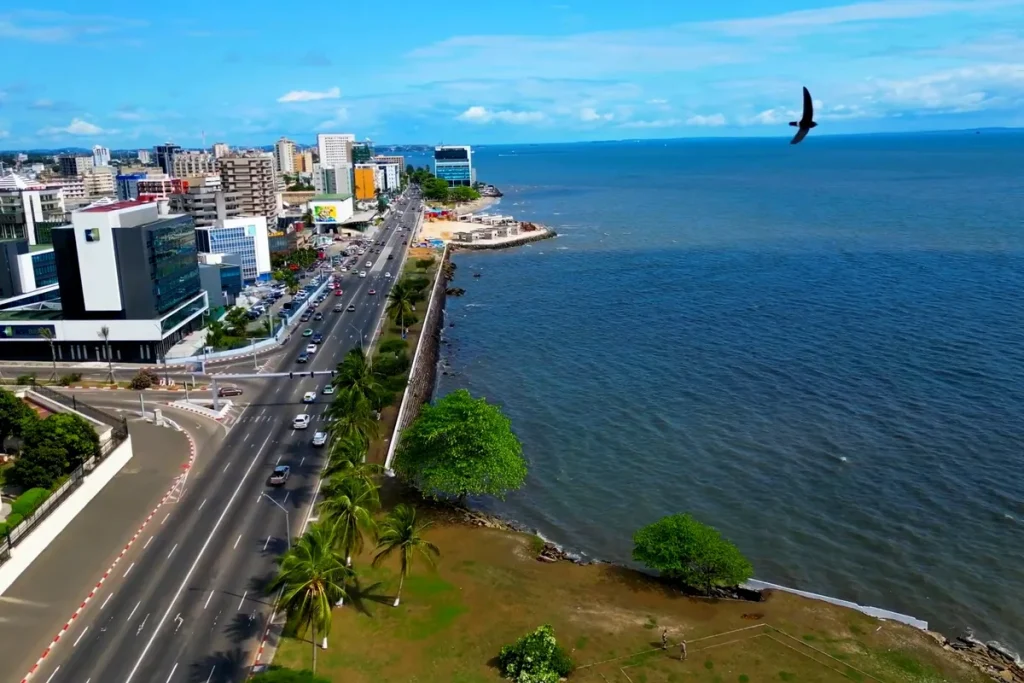
Photo: Shirmy25, CC BY-SA 4.0, via Wikimedia Commons.
The seafront boulevard in Libreville, Gabon’s capital, in April 2025.