NASA’s Voyager 1 has reached one light-day from Earth, the distance light travels in 24 hours, NASA’s Jet Propulsion Laboratory (JPL) said on 19 November. JPL puts that distance at about 16.1 billion miles (25.9 billion kilometres).
The spacecraft reached the mark at 2:16 a.m. PST (5:16 a.m. EST) on 18 November, after more than 49 years of constant travel, JPL said. Team members heard from the probe 24 hours later, early on Thursday 19 November, US time, the time the radio signal took to reach Earth.
Should the Voyager mission keep operating for as long as it can?
Choose an answer, then select Vote.
What a Light-Day Means
Light travels about 186,000 miles (299,000 kilometres) a second in a vacuum, JPL said. Sunlight takes about 1.3 seconds to reach the Moon and about four hours to reach Neptune. It needs “another 20 hours to reach Voyager 1”, the release said.
For the people running the mission, the distance is a matter of waiting. JPL said signals take 24 hours to reach the spacecraft and 24 hours to reach Earth.
“We listen to Voyager 1 every day and send commands to the spacecraft weekly. It just takes a little longer to communicate than it used to,” said Suzanne Dodd, the Voyager project manager at JPL.
A Probe Built for Five Years
Voyager 1 launched in 1977 with its twin, Voyager 2. In 2012 it became the first human-made spacecraft to enter interstellar space, and Voyager 2 crossed the boundary in 2018, JPL said. The agency calls them “Humanity’s only probes in interstellar space”. Each carries a Golden Record, a gold-plated copper phonograph of images and sounds from Earth.
CNN reported on 18 November that Voyager 1 has been the farthest human-made object since 1998, when it passed Pioneer 10, and that the probes were originally built to last just five years. It also said two of Voyager 1’s 10 scientific instruments, the magnetometer and the plasma wave subsystem, were still running. JPL said both probes lose about 4 watts of power each year.
To save power, engineers switched off three devices on Voyager 1 in 2026 and substituted three lower-power alternatives, “a move not without risk”, JPL said. Kareem Badaruddin, the Voyager mission manager at JPL, described the equipment to CNN this way: “We’re using very old machines to do something they weren’t really designed to do.”
The Open Question on Data
One question in NASA’s release is open. As at NASA’s release of 19 November, the team had not received science and engineering data from Voyager 1 since 14 November.
The spacecraft was sending a carrier signal, and mission engineers used it, with trajectory calculations, to confirm the light-day milestone, JPL said. NASA said engineers were analysing the issue affecting the data.
“An engineer with a problem is like a dog with a bone, so we are very busy and very energized to solve these problems,” Badaruddin said, according to Scientific American’s report of 19 November.
How Long It Can Last
The outlooks differ by outlet. JPL said in its 19 November release that the energy-saving change is expected to keep the science instruments running until at least their 50th launch anniversaries. CNN reported on 18 November that mission managers have continued to estimate the mission would last three to five more years. Scientific American reported on 19 November that Voyager 1 is expected to lose power in 2036, at which point it will no longer communicate with Earth.
CNN said Voyager 1 is heading toward Gliese 445, a star more than 17 light-years away, and will pass within about 1.7 light-years of it in about 40,000 years.
Listening Across a Light-Day
Joe Westlake, director of the Heliophysics Division at NASA Headquarters, said in the JPL release: “Traveling a light-day is a singular feat for a spacecraft, but Voyager is so much more than a distant traveler.”
Dodd, speaking at a press conference on Thursday 19 November, US time, said: “One light-day is a great milestone, but I think we’re going to have more milestones to come.” In the JPL release she said: “One day in the future, when it can no longer communicate with Earth, Voyager 1 will become humanity’s silent ambassador to the stars.”
prw reported on 24 October on Australia’s final bid to fly Katherine Bennell-Pegg to the ISS, and more space and technology coverage is in the Technology archive.
Sources: NASA Jet Propulsion Laboratory, “NASA’s Voyager 1 Makes History Reaching One Light-Day from Earth”, 19 November 2026 (https://www.jpl.nasa.gov/news/nasas-voyager-1-makes-history-reaching-one-light-day-from-earth/); CNN, “The farthest spacecraft from Earth reaches unprecedented milestone in interstellar space”, 18 November 2026 (https://www.cnn.com/2026/11/18/science/voyager-1-light-day); Scientific American, “Voyager 1 is a light-day away. What now?”, 19 November 2026 (https://www.scientificamerican.com/article/voyager-1-is-a-light-day-away-what-now/)
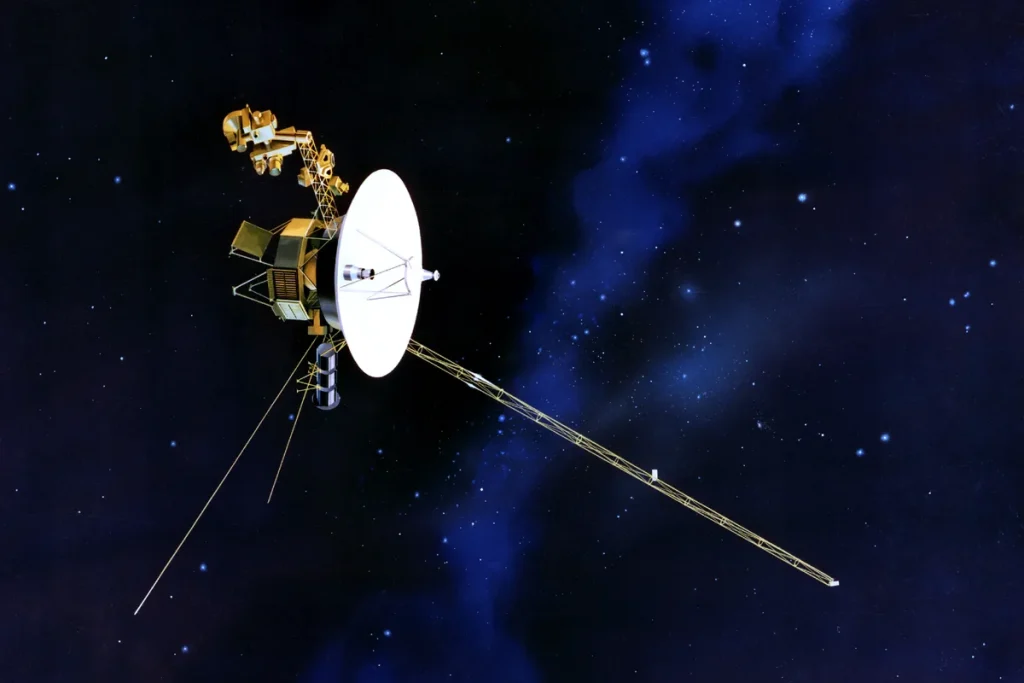
Image: NASA/JPL, public domain, via Wikimedia Commons.
An artist’s concept of a Voyager spacecraft in flight. Voyager 1 and its twin, Voyager 2, both launched in 1977.