- The Seoul Central District Court ruled that Yoon deliberately attempted to disrupt constitutional governance by deploying military forces to block lawmakers and interfere with parliamentary proceedings.
A South Korean court has sentenced former president Yoon Suk Yeol to life imprisonment with hard labour after finding him guilty of leading an insurrection linked to his failed martial law declaration in December 2024. The ruling marks one of the most consequential legal decisions in the country’s modern democratic history, highlighting the strength of constitutional safeguards and judicial independence in South Korea.
The verdict, delivered by the Seoul Central District Court, concluded that Yoon’s attempt to impose martial law constituted a deliberate effort to disrupt democratic governance. Prosecutors argued that he ordered military deployment around the National Assembly and attempted to block lawmakers from carrying out their constitutional duties.
According to the court, Yoon’s actions represented a direct threat to the constitutional order. Judge Jee Kui-youn stated that the declaration of martial law was intended to prevent parliamentary debate and voting by sending troops to secure the legislative building and arrest senior political leaders. The ruling emphasised that even elected leaders can be held criminally accountable if they undermine democratic institutions.
Martial Law Crisis That Shook South Korea’s Democracy
The events that led to Yoon’s conviction unfolded on 3 December 2024, when he declared martial law citing alleged threats from anti-state forces and unverified claims of election fraud. Within hours, the move triggered a nationwide political crisis.
According to official parliamentary records, 190 lawmakers forced their way into the National Assembly despite military blockades and passed an emergency resolution overturning martial law. This rapid response prevented the military takeover from succeeding and restored civilian authority within six hours.
The National Assembly impeached Yoon within 11 days of the declaration. In April 2025, the Constitutional Court upheld the impeachment, formally removing him from office.
Legal analysts described the attempted power consolidation as the most serious constitutional challenge South Korea has faced since its democratic transition in 1987.
Court Chooses Life Imprisonment Over Death Penalty
Under South Korean law, leading an insurrection carries penalties ranging from lengthy imprisonment to capital punishment. Prosecutors had requested the death penalty, arguing that Yoon’s actions caused severe damage to constitutional governance and public trust.
However, the court imposed life imprisonment instead, citing several mitigating factors. The judge noted that Yoon’s plans were not fully executed and that large-scale violence was avoided. The ruling also acknowledged that the military operation ultimately failed due to swift parliamentary intervention.
According to South Korea’s Criminal Act, life imprisonment with labour allows parole consideration after a minimum of 20 years, depending on behaviour and legal review.
Institutional Damage and Political Fallout
The court emphasised that the attempted martial law caused lasting damage to public confidence in government institutions. The ruling stated that the military and police, which are constitutionally required to remain politically neutral, were placed in a position that undermined their credibility.
Data from the Korean Institute for National Unification shows that public trust in government institutions declined sharply following the crisis. Public confidence in executive leadership dropped by nearly 18 percent between December 2024 and mid-2025.
Financial markets also reacted to the political instability. According to the Bank of Korea, the country’s benchmark stock index experienced a 7 percent decline in the week following the martial law announcement, reflecting investor concerns about governance risks.
Sentences for Other Senior Officials
The court also issued significant prison sentences to several senior officials connected to the insurrection attempt. These included:
| Official | Former Position | Sentence |
|---|---|---|
| Kim Yong-hyun | Defence Minister | 30 years |
| Noh Sang-won | Intelligence Commander | 18 years |
| Cho Ji-ho | National Police Chief | 12 years |
| Kim Bong-sik | Seoul Police Chief | 10 years |
| Mok Hyun-tae | Police Commander | 3 years |
Two additional defendants were acquitted due to insufficient evidence.
These sentences reflect the judiciary’s determination to enforce constitutional protections and deter future attempts to undermine democratic governance.
Historical Context: Presidential Accountability in South Korea
South Korea has a history of prosecuting former presidents, reflecting the country’s strong legal framework. Former president Park Geun-hye was sentenced to 32 years in prison in 2018 on corruption charges before receiving a presidential pardon in 2021.
Similarly, former military leaders Chun Doo-hwan and Roh Tae-woo were convicted in 1996 for their roles in a military coup and violent suppression of protests. Their sentences were later reduced, and both were pardoned.
South Korea’s legal system allows presidential pardons, meaning life imprisonment does not necessarily guarantee permanent incarceration.
Timeline of Key Events in the Insurrection Case
| Date | Event |
|---|---|
| 3 Dec 2024 | Martial law declared |
| 3 Dec 2024 | Parliament overturns martial law |
| 14 Dec 2024 | President impeached |
| Apr 2025 | Constitutional Court removes president |
| Feb 2026 | Court convicts and sentences former president |
Public Reaction Reflects Deep Political Divisions
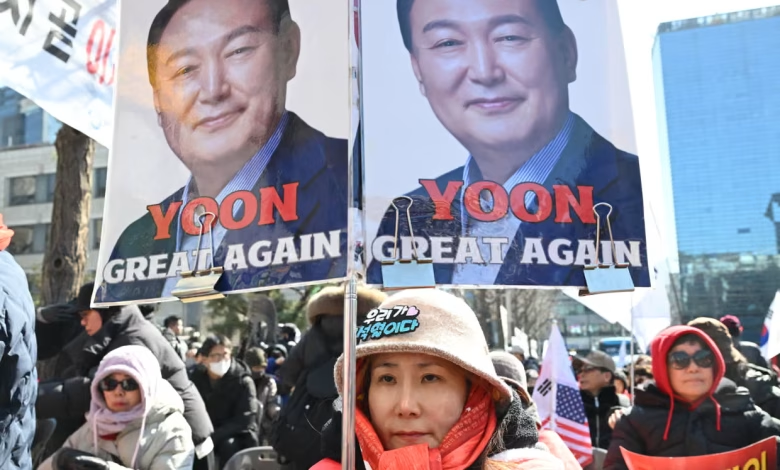
The verdict sparked strong reactions across South Korea. Supporters of the former president gathered outside the courthouse, protesting the ruling and accusing the judiciary of political bias. At the same time, civil society groups and opposition supporters welcomed the decision as a victory for democracy and the rule of law.
According to survey data from Gallup Korea, public opinion remained sharply divided, with approximately 48 percent supporting the conviction and 42 percent opposing it.
Legal Appeals and Future Implications
Yoon’s legal team has announced plans to appeal the decision, describing the trial as politically motivated. The appeals process could take several years, with the Supreme Court expected to review the case.
Legal experts believe the ruling reinforces the principle that no political leader is above the law. According to the Korean Bar Association, the conviction demonstrates the judiciary’s independence and the resilience of democratic institutions.
Broader Impact on South Korea’s Political Stability
South Korea is the world’s 10th largest economy, with a gross domestic product exceeding $1.7 trillion, according to the International Monetary Fund. Political stability is considered essential to maintaining investor confidence and economic growth.
Experts say the court’s decision sends a clear message that constitutional order will be protected regardless of political status. While the case has exposed political divisions, it also highlights the strength of democratic institutions established since the country’s transition from military rule in the late 20th century.
Conclusion
The life sentence imposed on former president Yoon Suk Yeol marks a historic moment in South Korea’s democratic development. The ruling underscores the judiciary’s authority to hold even the highest office accountable for actions that threaten constitutional governance.
While appeals and political debate will continue, the case reinforces the principle that democratic systems rely on legal accountability. The outcome will likely influence South Korea’s political landscape and institutional stability for years to come.