G7 leaders agreed on Friday to release 100 million barrels of diesel and crude oil from their reserves over the next four months, in a move coordinated through the International Energy Agency and aimed at bringing fuel prices down.
The same leaders also pledged not to restrict energy exports to one another. That commitment followed US President Donald Trump floating a ban on US diesel exports, an idea the European Commission rejected outright.
G7 nations will release 100 million barrels of oil and diesel from reserves. Do you expect fuel prices to ease by summer?
Choose an answer, then select Vote.
What Was Agreed
The deal was reached on Friday 2 October in a video conference chaired by French President Emmanuel Macron, who called the meeting after a conversation with Mr Trump, according to AFP copy carried by the ABC. The other G7 members are Britain, Canada, Germany, Italy, Japan and the United States.
The terms are set out in a leaders’ statement released by Mr Macron’s office. As reported by the ABC, it says the release is “to begin immediately over four months, including a front-loaded substantial diesel release within the first 20 days”.
Mr Trump confirmed the timing on his Truth Social platform. “The process will begin immediately,” he wrote, as reported by the ABC.
The Diesel Export Dispute
The export pledge sits in the same statement. “We reaffirm our commitment to refrain from export restrictions on energy and energy products between G7 countries and call on all producers to refrain from imposing bans that could exacerbate market tensions,” the leaders said, according to the ABC.
The wording comes after Mr Trump raised the prospect of stopping US diesel from leaving the country. “We fully reject any ban on diesel,” European Commission spokeswoman Anna-Kaisa Itkonen said, as reported by the ABC.
Diesel runs through both halves of Friday’s agreement: it leads the release schedule, and it was the fuel at the centre of the export row.
Why Now
The surge in energy prices follows the US-Israeli war with Iran, Al Jazeera reports, with shipping through the Strait of Hormuz disrupted since 28 February.
Mr Macron said shipments had improved. According to Al Jazeera, he said three-quarters of prewar volumes were moving between Hormuz and the Yanbu pipeline.
Friday’s agreement is not the first coordinated release this year. In March, the IEA’s 32 members agreed to release 400 million barrels, which the ABC describes as their largest release ever.
The timing matters in Washington too. US midterm elections are about a month away, the ABC notes, and fuel costs are a key issue.
How Markets Responded
Oil prices fell after the announcement. Brent crude dropped 1.48 per cent to US$100.80 a barrel, while West Texas Intermediate fell 2.66 per cent to US$90.40, according to The National.
Australia is not a G7 member. Higher fuel costs have, however, fed into inflation here, part of the backdrop to the Reserve Bank’s latest rate rise.
What the Release Does Not Settle
The statement sets out a volume and a timetable. It does not set a price target, and Brent was still above US$100 a barrel after Friday’s fall.
The release is also a quarter of the size of the one the IEA’s members agreed in March, and on Mr Macron’s own account, shipping through Hormuz has not returned to prewar volumes.
The first test is the front-loaded diesel tranche, due within 20 days. The rest of the 100 million barrels follows over the four months, with the G7’s export pledge standing alongside it.
Sources: ABC News, “G7 countries to release 100 million barrels of diesel and oil to curb fuel prices”, 3 October 2026 (https://www.abc.net.au/news/2026-10-03/g7-to-release-100m-barrels-oil-in-bid-to-curb-soaring-prices/107224282); The National, “G7 members agree to release 100 million barrels of diesel and other reserves”, 2 October 2026 (https://www.thenationalnews.com/business/energy/2026/10/02/g7-members-agree-to-release-100-million-barrels-of-diesel-and-other-reserves/); Al Jazeera, “G7 to release 100m oil barrels as Trump hails Europe diesel deal”, 2 October 2026 (https://www.aljazeera.com/news/2026/10/2/trump-says-europe-agrees-to-release-massive-amount-diesel-stockpile)
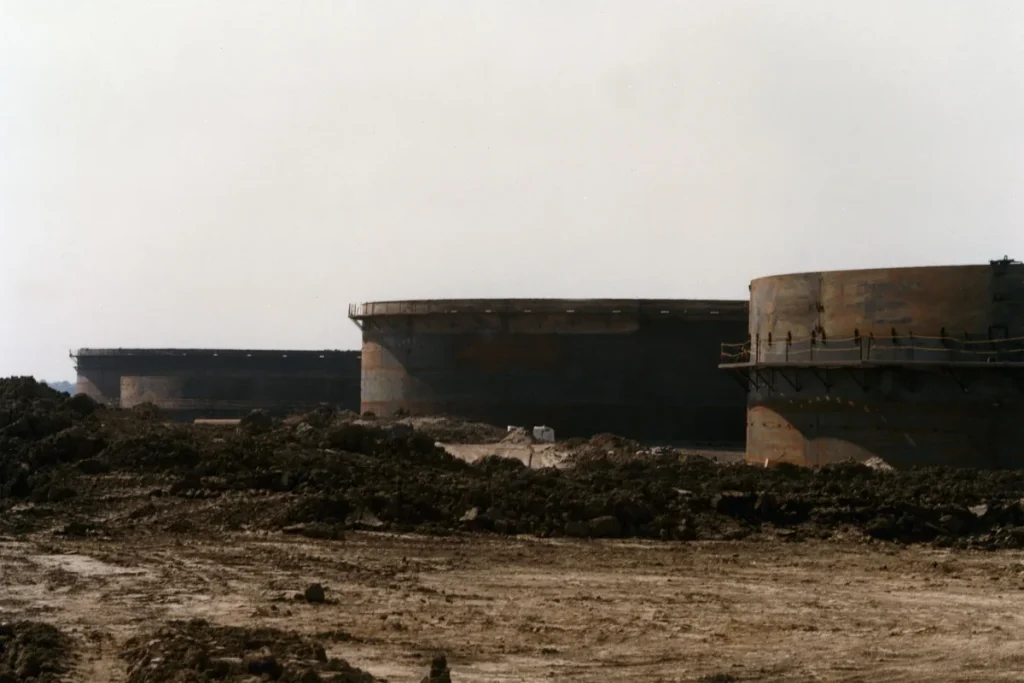
Photo: US Department of Energy, public domain, via Wikimedia Commons.
Crude oil storage tanks at the St James terminal of the United States Strategic Petroleum Reserve, in an archive Department of Energy photograph. G7 leaders agreed on 2 October 2026 to release 100 million barrels from reserves; this photograph is not from the announcement.