
Every vote from Israel’s election on Tuesday 27 October has been counted, and no bloc has the 61 seats needed to govern.
Final results were released early on Friday 30 October, Israel time, The Guardian reported. Netanyahu’s bloc won 53 seats and Gadi Eisenkot’s bloc won 48, according to BBC News.
The Arab-led Joint List and Ra’am won a record 19 seats after a surge in Arab turnout, the BBC reported. Ra’am is projected to win eight of those 19, according to Al Jazeera.
The Knesset has 120 seats. Neither bloc reached 61.
The count is not quite the last word. Results will be certified and announced by Wednesday 4 November and are subject to change until then, Al Jazeera reported.
On 24 October, prw’s election preview set out the road to 61 seats.
Three Ways to a Government
The BBC sets out three plausible options. The first is a national unity government with Netanyahu and Eisenkot. The second is a right-wing coalition with defectors from Eisenkot’s bloc. The third is an Eisenkot-led government supported by the Arab parties.
That third option runs into the opposition’s own position. Eisenkot and every member of his bloc bar one have refused to enter government with Arab parties, the BBC reported.
Opposition voters see it differently. A Hebrew University snap poll found that the most popular option among voters for every opposition party was an Eisenkot minority government with Ra’am, supported from outside by the Joint List, according to the BBC.
The meetings have already started. On Thursday 29 October Eisenkot met former prime minister Naftali Bennett and Democrats leader Yair Golan, Al Jazeera reported. Golan met Ra’am leader Mansour Abbas.
“This is a time for action. Our responsibility is not to miss the opportunity for change and the salvation of Israel,” Golan wrote in a post on X, according to Al Jazeera.
The Interference Row
Then came the claims about the vote itself. Likud alleged that voters were “bribed” to vote for Arab parties, the BBC reported.
The head of the Central Elections Committee, Supreme Court Justice Noam Sohlberg, asked Shin Bet to investigate “serious suspicions” of foreign interference, according to Al Jazeera. He said he could not verify the claims.
Shin Bet said its inquiry did not implicate a community that voted legally, the BBC reported. Qatar’s foreign ministry denied the allegations. According to the BBC, acting CEC director general Dean Livne said there was “no basis for allegations of systematic violations of election integrity.”
Eisenkot answered in a video message.
“It’s already clear that Likud and Netanyahu have embarked on a coordinated, organised campaign seeking to delegitimise the results of the election,” he said, The Guardian reported.
President Isaac Herzog urged people to “avoid tarnishing an entire community that sought to exercise its right to vote and take an active part in democracy”, according to the paper.
The Joint List’s leader, Yousef Jabareen, put it more simply. “Netanyahu was defeated at the ballot box,” he said, The Guardian reported.
Who the Stalemate Suits
Netanyahu, 77, has run Israel for 19 of the past 30 years, according to The Guardian.
Times of Israel editor David Horovitz argued that the stalemate favours Netanyahu, because the opposition has no realistic way to oust him.
More world news is in prw’s International archive.
Certification, Then the Bargaining
The new Knesset is due to be sworn in within 14 days of the election, The Guardian reported. Opposition parties have discussed voting together to replace the Speaker, Amir Ohana.
First, the results have to be certified by Wednesday 4 November. No government has been formed, and the coalition talks are still to come.
Sources: BBC News, “Israeli opposition accuses Netanyahu of trying to ‘delegitimise’ election”, 29 October 2026 (https://www.bbc.co.uk/news/articles/ckdd8qdl9e0eo); Al Jazeera, “Israel election result shows no overall majority as vote count complete”, 29 October 2026 (https://www.aljazeera.com/news/2026/10/29/israel-election-result-shows-no-overall-majority-as-vote-count-complete); The Guardian, “Netanyahu accused of smearing Arab voters to hold on to power”, 29 October 2026 (https://www.theguardian.com/world/2026/oct/29/israeli-leader-netanyahu-accused-of-using-ugly-smear-tactics-to-cling-to-power); The Times of Israel, “Israel’s election yielded a stalemate. Which means Netanyahu won”, 29 October 2026 (https://www.timesofisrael.com/israels-election-yielded-a-stalemate-which-means-netanyahu-has-won/)
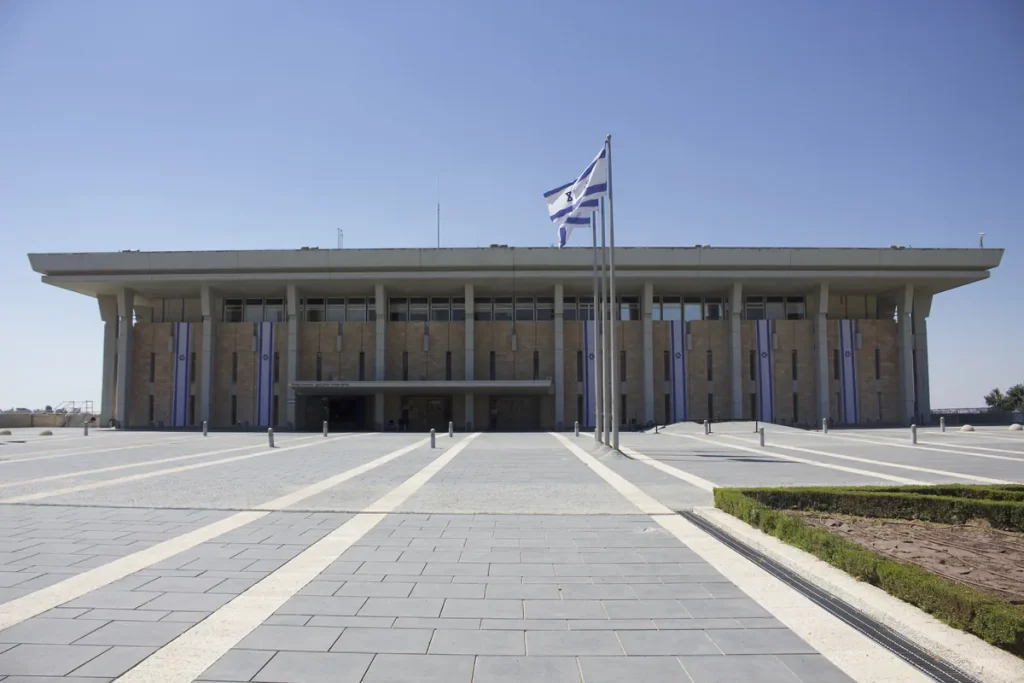
Photo: Clema12, CC BY-SA 4.0, via Wikimedia Commons.
The Knesset in Jerusalem, where the 120 members elected on 27 October are due to be sworn in.