A split Monetary Policy Board lifted Australia’s cash rate to 4.85 per cent on Tuesday 3 November, with six members in favour and three wanting no change, the Reserve Bank of Australia said.
The rise of 25 basis points was announced at 2.30pm AEDT. It is the fifth increase of 2026, and the cash rate was last this high in late 2008, ABC News reported.
The statement recorded the vote: “Today’s policy decision was by majority: six members voted to increase the cash rate target by 25 basis points to 4.85 per cent; three members voted to leave the cash rate target unchanged at 4.60 per cent.”
Was the RBA right to raise rates on Tuesday 3 November?
Choose an answer, then select Vote.
The Board’s Reasons
In its statement, the Board said: “Given the revised inflation outlook and the continuing upside risks, the Board judged that a further tightening in financial conditions is warranted to support the return of inflation to target.”
Its contact with businesses pointed the same way: “Liaison indicates that many firms are experiencing cost pressures and are either increasing the prices of their goods and services in response or looking to do so.”
On inflation expectations, it said: “This presents upside risks to inflation expectations; some measures are assessed to have risen lately.”
Market expectations of a move firmed after Deputy Governor Andrew Hauser described the inflation outlook as “materially worse” on 21 October, The Nightly reported. Futures markets had rated an increase on Tuesday 3 November an 80 per cent chance, the paper said.
Not Just Oil
Governor Michele Bullock spoke at a press conference after the release on Tuesday 3 November. “Inflation is too high, and our forecasts suggest it will stay higher for longer,” she said, according to ABC News.
On oil, she said: “However, I want to be very clear that we are not tightening monetary policy because of the direct impact of oil prices on inflation.”
Monetary policy cannot move global oil prices, Bullock said. Domestic capacity pressures existed before the oil shock, she said, and that is why the RBA raised rates in February. “We now think that those pressures were greater and contributed more to inflation than we judged before.”
She explained how fuel feeds into other prices. “Fuel is an important input to many parts of the economy. So as oil prices have risen, businesses have seen their costs rise and they are looking to pass on these costs to the prices of the other goods and services they produce.”
Bullock acknowledged the strain on households. “Again, I know this interest rate rise is tough news for many households, but this is the right thing for the Australian economy,” she said, according to The Nightly.
Why Three Members Wanted to Wait
The three members who voted to hold gave more weight to the downside risks, Bullock said: the housing downturn, the rising unemployment rate and the absence of any sign that wage growth is accelerating. Their position, as she described it, was “maybe we should wait a bit longer to get some more data to test that”.
The vote is the fourth split since the new Board began in early 2025, ABC News reported, and 75 per cent of those splits have come in 2026.
A Fifth Rise
The cash rate has risen 125 basis points since February, from 3.6 per cent, The Nightly reported. prw reported the fourth of those rises on 29 September, when the Board took the rate to 4.60 per cent.
A rate change takes between 12 and 18 months to flow fully through the economy, ABC News reported, so the full effect of this rise will not be known until 2028.
What the Board Says It Will Watch
The RBA wants annual inflation of around 2.5 per cent on average over the cycle, ABC News reported.
On the outlook, the Board said: “The Board will continue to do what it considers necessary to bring inflation sustainably back to target.”
More reporting on the economy is in prw’s Business archive.
Sources: Reserve Bank of Australia, “Statement by the Monetary Policy Board: Monetary Policy Decision”, Media Release 2026-30, 3 November 2026 (https://www.rba.gov.au/media-releases/2026/mr-26-30.html); ABC News, “RBA lifts interest rates to highest level in 18 years to try to dampen inflation”, 3 November 2026 (https://www.abc.net.au/news/2026-11-03/rba-lifts-interest-rates-november-2026-highest-rate-in-18-years/107340050); ABC News, “Interest rates live updates: RBA hikes cash rate to 18-year high of 4.85 per cent”, 3 November 2026 (https://www.abc.net.au/news/2026-11-03/rba-interest-rates-markets-live-coverage/107338216); The Nightly, “RBA interest rates: Monetary board hikes to 18-year high of 4.85 per cent to combat rising inflation”, 3 November 2026 (https://thenightly.com.au/business/rba-interest-rates-monetary-board-hikes-to-18-year-high-of-485-per-cent-to-combat-rising-inflation-c-23107562)
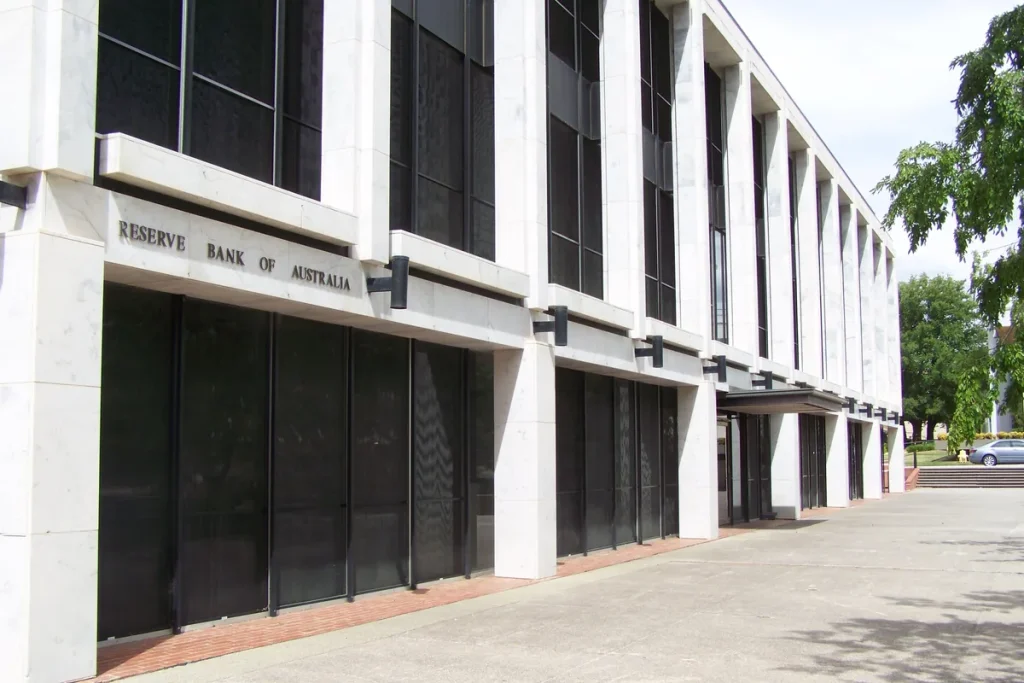
Photo: Ché Lydia Xyang, CC BY-SA 3.0, via Wikimedia Commons.
The Reserve Bank of Australia’s Canberra building, its name set above the entrance, pictured in December 2009. The photograph predates the Board’s decision of 3 November.