
The United States has lost its measles elimination status, the Pan American Health Organization (PAHO) announced in Washington on Tuesday 17 November. PAHO said “endemic measles transmission was determined to have been re-established in Bolivia, Mexico, and the United States. All three countries have therefore lost their measles elimination status.”
Is your measles vaccination up to date?
Choose an answer, then select Vote.
What PAHO Found
The finding followed a meeting from 10 to 13 November of PAHO’s regional re-verification commission, whose recommendations were accepted by PAHO Director Dr Jarbas Barbosa. PAHO’s test is that “endemic transmission is considered re-established when the same measles virus genotype and lineage circulate uninterrupted for 12 months or more in a country.”
In the United States, according to PAHO’s question-and-answer page of 17 November, the outbreak began on 20 January 2025 and reached the 12-month threshold on 20 January 2026. PAHO said losing status “does not mean that all parts of these countries are experiencing outbreaks”; it means the virus has circulated continuously for at least 12 months.
As at 13 November, the Americas had reported 58,213 confirmed measles cases, compared with 12,806 in the same period of 2025, PAHO said. The region regained status in 2024 and lost it in November 2025 after sustained transmission in Canada. PAHO said Canada “has interrupted the chain of transmission associated with the outbreak that led to its loss of status” and is working to regain it. In January 2026, the World Health Organization announced that six countries in the European Region, including Spain and the United Kingdom, had lost their status.
The US Numbers
The CDC’s measles page, updated on 13 November, reported 5,412 confirmed measles cases in the United States in 2026 as at 12 November. It listed 6 deaths and said the figure is “subject to change”.
Other outlets report different death figures, each its own. The Guardian reported eight deaths in 2026. The New York Times, as published by The Sydney Morning Herald, reported that “10 people have died”, and that five of the 10 deaths were in children too young to be vaccinated and the rest in unvaccinated adults.
The Guardian described the outbreak as the worst since 1991 and said the disease had been eliminated for 26 years. The Times reported that cases are more than double the tally for 2025 and the highest since 1991, that about 11 per cent of US patients in 2026 were hospitalised, and that about 96 per cent of known cases were in people who were unvaccinated or whose status was unknown. It also reported that the CDC has given states $US100 million to bolster immunisation and surveillance.
What It Means for People
The Times reported that doctors and schools will need to prepare to quarantine anyone who is unvaccinated and exposed for 21 days. In its report of 18 November, The Guardian said Americans face new risks of infection and are being asked to find old vaccination certificates and possibly quarantine for 21 days. It said measles “requires 95% of the community to be vaccinated to prevent outbreaks”.
According to the Times, measles “lingers in the air for hours and infects nine of every 10 unprotected people who are exposed to it”, and there is no specific treatment; doctors rely on antiviral drugs and supportive care. The vaccine arrived in 1963 and a second dose in 1989, the paper said. The Times wrote: “Decades of studies have shown that the measles vaccine is safe.” The Guardian wrote: “The measles vaccine is safe and highly effective.”
Official Responses
The CDC said in a statement on Tuesday 17 November, US time, that it would “encourage vaccination, expand access to vaccines and help communities close gaps in protection”, the Times reported.
The Guardian reported that Health Secretary Robert F Kennedy Jr said in a post on X that the US “will stop measles outbreaks, protect American families, and work to regain U.S. measles elimination status” and that he would “continue to recommend MMR vaccination as the most effective way to prevent measles”. The American Medical Association called it a “deeply troubling and entirely preventable setback for our nation”, according to the Guardian.
What Regaining Status Would Take
PAHO said a country regains status by demonstrating that endemic transmission has been interrupted and by meeting re-verification requirements. The Times reported that regaining status is likely to take years, even with rigorous effort, and that vaccination rates would have to return to 95 per cent. Noel Brewer of the University of North Carolina at Chapel Hill, who chairs a committee that considered the evidence on US status, called for a national plan to eliminate measles again, the Guardian reported.
“This is a serious warning for our Region, but it is not an irreversible setback,” Barbosa said in PAHO’s release of 17 November.
Further coverage is in prw’s Health archive and International archive.
This report is general news and not medical advice.
Sources: Pan American Health Organization, “PAHO urges countries to step up efforts to stop measles outbreaks and move towards elimination in the Americas”, 17 November 2026 (https://www.paho.org/en/news/17-11-2026-paho-urges-countries-step-efforts-stop-measles-outbreaks-and-move-towards); Pan American Health Organization, “Measles in the Americas: Questions and Answers: Technical Reference for Journalists and the Public”, 17 November 2026 (https://www.paho.org/en/news/17-11-2026-measles-americas-questions-and-answers-technical-reference-journalists-and-public); US Centers for Disease Control and Prevention, measles data page, updated 13 November 2026 (https://www.cdc.gov/measles/data-research/index.html); The Guardian, “US loses measles elimination status amid worst outbreak since 1991”, 18 November 2026 (https://www.theguardian.com/us-news/2026/nov/17/us-measles-outbreak-elimination-status); The New York Times, “‘A new Wild West’: Measles is officially back in the US. What now?”, as published by The Sydney Morning Herald, 18 November 2026 (https://www.smh.com.au/world/north-america/a-new-wild-west-measles-is-officially-back-in-the-us-what-now-20261118-p61f61.html)
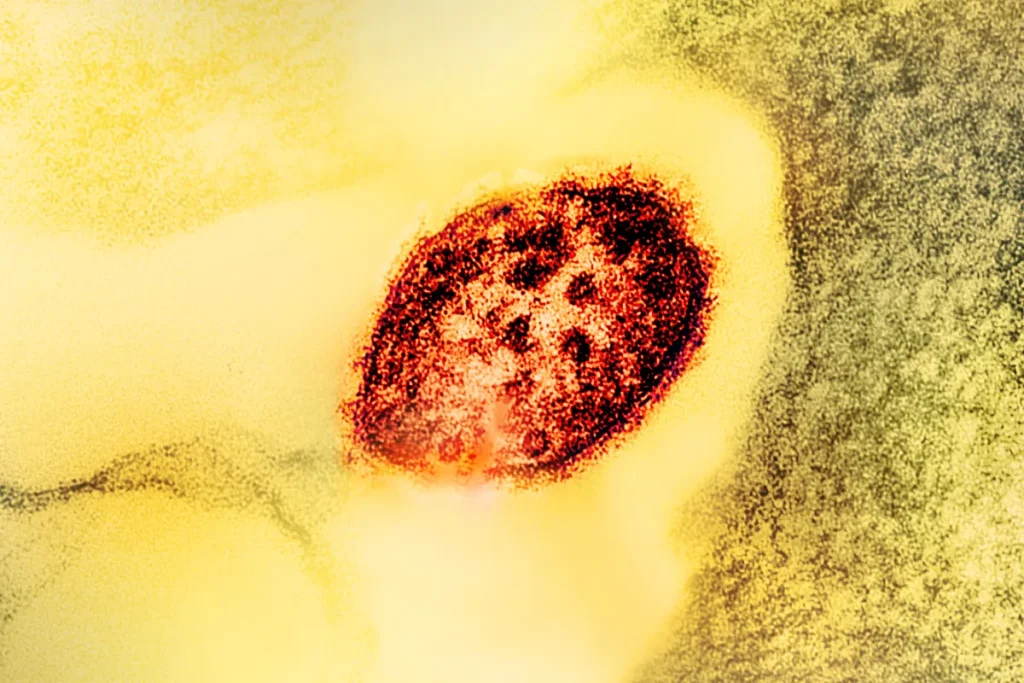
Image: CDC microscopy, layout and colourisation by NIAID, CC BY 2.0, via Wikimedia Commons.
A colourised transmission electron micrograph of a measles virus particle (red). Microscopy by the US Centers for Disease Control and Prevention; colourisation by the National Institute of Allergy and Infectious Diseases.