The United States and Venezuela have agreed to strengthen military cooperation, Al Jazeera reported, in an arrangement announced during a visit to Caracas by US defence secretary Pete Hegseth on Wednesday 18 November, local time. This report is written as at Friday 20 November, and few details have been made public.
Al Jazeera said the two countries “have agreed to strengthen military cooperation in several areas, including joint training, intelligence sharing, military equipment and border security”. It also reported that “the full terms of the agreement have not been made public, including details of how the two countries would carry out joint military operations”.
Should the US and Venezuela publish the terms of the agreement?
Choose an answer, then select Vote.
Signed or Announced
Accounts differ on one point. BBC News reported that the agreement was signed by Hegseth and Venezuela’s defence minister on Wednesday 18 November. Al Jazeera described it as announced and said the full terms had not been made public. The Guardian reported Hegseth vowing to deepen cooperation in brief comments broadcast by the state broadcaster VTV, and does not describe a signing.
Who Met Whom
Hegseth met interim President Delcy Rodríguez and Defence Minister Gustavo González López in Caracas, Al Jazeera reported. The Guardian said he was welcomed at Miraflores Palace and that Rodríguez was joined by senior cabinet members, including the defence and foreign ministers, Gustavo González López and Oliver Blanco.
BBC News described Rodríguez as Maduro’s former vice-president and said Hegseth travelled on to Colombia.
What Each Side Said
“It’s a great honour to be here as the first United States Secretary of War this century to set foot in Venezuela. The weight of this moment does not escape me,” Hegseth said at the US embassy in Caracas, BBC News reported.
BBC News said Hegseth told the audience Venezuela had “gone from our most aggressive regional threat to a compliant security partner” in less than 12 months. It said he called the arrangement a “new chapter for the United States, for Venezuela, for the Venezuelan military and for the Western Hemisphere through the Americas Counter Cartel Coalition”.
In her speech, Rodríguez said the agreement would help confront “common threats” and was “extraordinarily relevant for our bilateral relations”, according to BBC News. The Guardian quoted her saying the two governments had turned what were very difficult times into “an extraordinary space for cooperation and mutual benefit.”
In his first statement since taking office, González López said the new relationship follows the “painful events of January 3”, and that cooperation with Washington would follow Venezuela’s constitution and respect the country’s “sovereignty, independence and territorial integrity”, Al Jazeera reported. Al Jazeera also said the Trump administration has argued that closer military cooperation will help fight drug trafficking and armed groups and improve security in the region.
How It Got Here
BBC News reported that military cooperation between the two countries was ended in 2005 by Hugo Chávez, who alleged that US military personnel sent to train their counterparts had made disparaging remarks about his government. Relations deteriorated further under Maduro.
US forces seized Maduro in a raid on 3 January, BBC News reported. As at its report of 19 November, he and his wife, Cilia Flores, were in custody in New York on charges of drug-trafficking and conspiracy to commit torture, which they deny.
Critics and Analysts
The Guardian reported that critics of Rodríguez’s movement painted the visit as a humiliating act of genuflection.
“The simple answer is that they want to remain in power as long as possible,” Phil Gunson, a senior analyst at the International Crisis Group, said of Rodríguez’s government, in an Al Jazeera explainer.
“In its current state, the military as an institution is not in a position to resist US influence, for good or ill,” Gunson said of the armed forces.
What Has Been Said, and What Has Not
As at Friday 20 November, the terms of the agreement had not been published. The US account, as Al Jazeera reported it above, is that the agreement will help fight drug trafficking and armed groups. The Venezuelan account, from Rodríguez and González López, is that it serves shared interests and respects sovereignty. Critics and analysts quoted above describe it differently.
Until the text is released, what the outlets report is what is known. Further coverage of world affairs is in prw’s International archive.
Sources: BBC News, “Venezuela signs military deal with US less than a year after Maduro’s removal”, 19 November 2026 (https://www.bbc.com/news/articles/cmwy8pyqlq5vo); The Guardian, “Hegseth uses Venezuela visit to boast of Maduro’s capture by US military”, 19 November 2026 (https://www.theguardian.com/world/2026/nov/18/pete-hegseth-venezuela-nicolas-maduro-military); Al Jazeera, “Why is Pete Hegseth strengthening US military ties with Venezuela?”, 19 November 2026 (https://www.aljazeera.com/news/2026/11/19/why-is-pete-hegseth-strengthening-us-military-ties-with-venezuela)
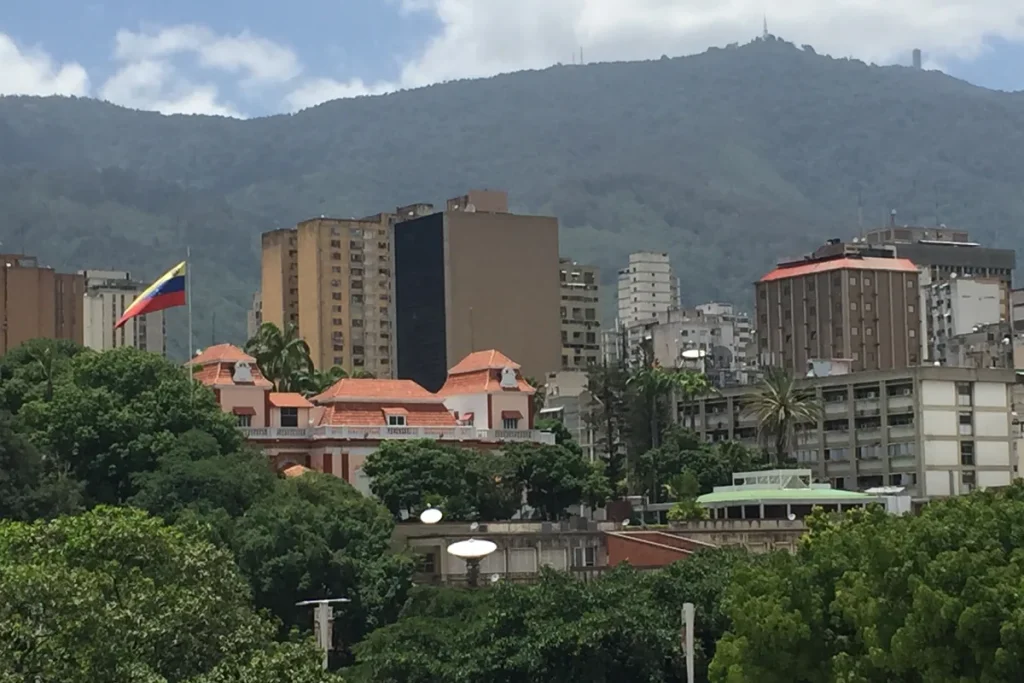
Photo: Guillermo Ramos Flamerich, CC BY-SA 4.0, via Wikimedia Commons.
The Miraflores presidential palace in Caracas, photographed from El Calvario park in July 2015.