
Astronomers have described a rare triple star system about 28 light-years from Earth, in a paper published in Astronomy & Astrophysics on Thursday 19 November.
A team led by Étienne Artigau at the Trottier Institute for Research on Exoplanets, Université de Montréal, found a white dwarf orbiting a red dwarf. That pair forms a triple system with a second, more distant white dwarf that was already known. The team calls the system Welopōʻai.
Space.com said the name is a portmanteau of two Hawaiian words that means path of family traits.
Do you look up at the night sky?
Choose an answer, then select Vote.
How It Was Found
Space.com said the triple system was found “fortuitously”. Artigau said in a statement: “We were actually looking for planets,” and “Instead, we found something much more surprising.”
The search used SPIRou, an instrument on the Canada-France-Hawaii Telescope on Maunakea, Space.com said. It picked up a radial-velocity signal of about 16 km/s, peak to peak, over 4.8 years, which the paper’s abstract calls “inconsistent with planetary companions” and Sci.News described as “far too large for any planet”.
Imaging then identified the source. According to the abstract, speckle imaging with ‘Alopeke at Gemini North and infrared imaging with GNIRS confirmed a white dwarf at sub-arcsecond separation. Sci.News put the separation at about 0.6 arcseconds.
Why Astronomers Call It Puzzling
“The unusual combination of high mass and very low brightness left only one plausible explanation: it was the remnant of a dead star,” said Charles-Antoine Parent, an undergraduate student at Université Laval and a co-author, as Space.com reported.
Space.com said the white dwarf’s progenitor star would have had a mass about 40 per cent greater than the Sun’s. When it became a red giant, Space.com said, it should have destabilised the red dwarf’s orbit and possibly even sent it crashing into the giant. Yet the red dwarf is in a stable orbit.
Patrick Dufour of the Université de Montréal added: “This system should not exist,” and “We have no clean explanation for how it got here.” “That is the question driving our next observations,” he said.
The Numbers
The paper’s abstract, posted on arXiv on Wednesday 18 November, gives the inner pair’s orbit as a semi-major axis of 4.644 astronomical units and a period of about 9.83 years. Space.com said that is “closer than Jupiter orbits our sun”. Sci.News, reporting on Thursday 19 November, also gave the period as 9.8 years.
The abstract gives the masses as about 0.42 times the Sun’s mass for the red dwarf and about 0.62 for the white dwarf, and says the white dwarf’s mass is determined at the 0.7 per cent level. Space.com said both masses were measured to within an uncertainty of less than 1 per cent.
The outer white dwarf is at a projected separation of 123.9 astronomical units from the inner pair, with a period above 1,000 years, according to the abstract.
The abstract calls Welopōʻai “the closest known triple containing multiple white dwarfs”. Space.com said there is no similar system within at least 100 light-years.
A Tentative Hint of Dust
The abstract reports a tentative near-infrared excess towards the inner white dwarf that “further hints at circumstellar dust”. Sci.News said the astronomers “stress it needs confirmation”. Future observations, including with Webb and Gaia, could settle the system’s three-dimensional layout and the infrared question, Sci.News reported.
A System Without an Explanation Yet
“Discoveries like this remind us that our own cosmic neighborhood still contains remarkable surprises,” Artigau said, according to Space.com.
The paper and the team describe the system and its measurements. How it came to exist is the open question.
prw reported on Saturday 21 November on Voyager 1 reaching one light-day from Earth, and on Wednesday 25 November on modelling that proposes a hidden planet beyond Neptune. More space and technology coverage is in the Technology archive.
Sources: Space.com, “Astronomers just discovered a rare triple star system 28 light-years away, and they have ‘no clean explanation for how it got here’”, 23 November 2026 (https://www.space.com/astronomy/stars/astronomers-discover-rare-triple-star-system-just-28-light-years-from-earth-and-they-have-no-idea-how-it-has-survived); Sci.News, “Astronomers Find Hidden White Dwarf Lurking in Nearby Binary System”, 19 November 2026 (https://sci.news/astronomy/welopoai-hierarchical-triple-system-15210.html); Artigau et al., “Welopō’ai: A peculiar triple system 8 pc from the Sun”, Astronomy & Astrophysics, arXiv record, 18 November 2026 (https://arxiv.org/abs/2611.24533)
Image: NASA, ESA and G. Bacon (STScI), CC BY 4.0, via ESA/Hubble.
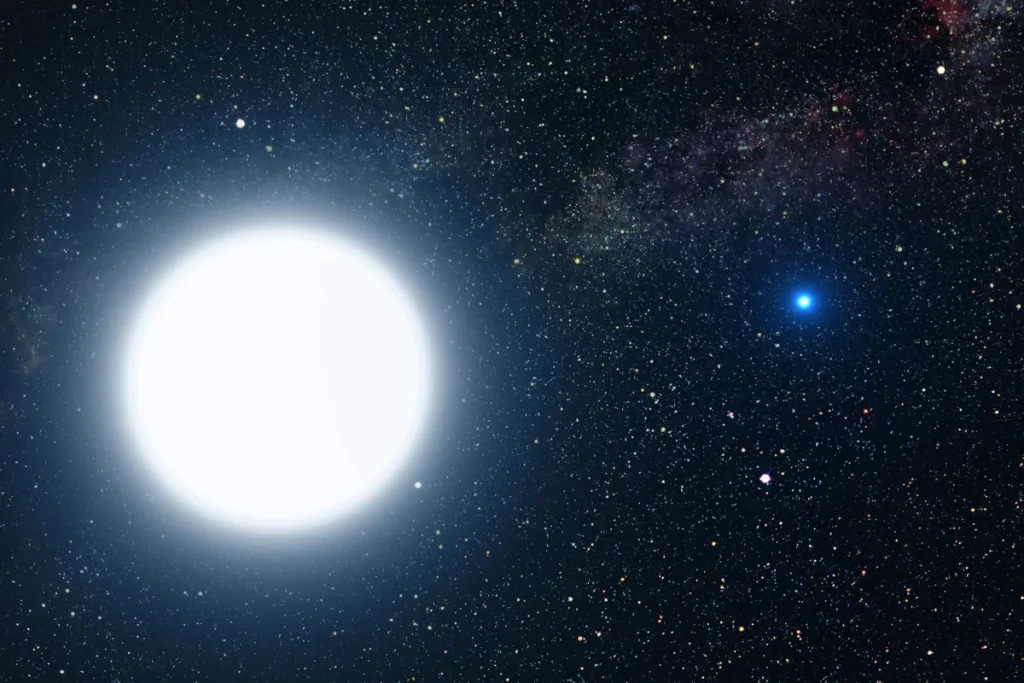
An artist’s rendering of Sirius A, the big bright star, and Sirius B, a small blue white dwarf at right. Welopōʻai, the system described in this report, is a different one.