
Australia does not need or want Russian fuel and will not change its approach, Energy Minister Chris Bowen said on Saturday, after US President Donald Trump announced a deal for Russia to supply diesel to the United States and global markets.
Bowen made the comments at his regular Saturday morning press conference on fuel reserves, according to the Guardian. “We don’t need or want Russian fuel in Australia,” he said.
Should Australia keep refusing Russian fuel while supply is tight?
Choose an answer, then select Vote.
Australia Holds Its Position
Bowen said the decision in Washington would not shift the government’s stance. “We do not want Vladimir Putin to benefit from this war in the Middle East. What the United States does is a matter for them. But we won’t be changing our approach,” he said at the press conference, the Guardian reported.
He also said “Russia should not be rewarded for their illegal and immoral invasion of Ukraine”, according to the Guardian.
Bowen will lead negotiations at next month’s UN climate talks in Turkey, and he met senior Saudi representatives at a preparatory meeting in Fiji, the Guardian reported.
One Nation leader Pauline Hanson, asked at a press conference on the sidelines of CPAC in Brisbane, did not rule out supporting a similar deal for Australia, the Guardian reported.
“If it’s going to get supplied all throughout the world, because a lot of countries are suffering from this lack of oil, I think it’s important to work with countries, if we can have the resources that we need,” Hanson said. She did not answer a follow-up question on Russian oil specifically, according to the Guardian.
The Diesel Deal
Trump said on social media that Russia would supply 300,000 tons of diesel immediately and 500,000 tons in November, the Guardian reported.
The US Treasury’s Office of Foreign Assets Control has issued a temporary six-month general licence for Russian diesel imports, SBS News reported. Trump confirmed on Friday that sanctions on Russian diesel exports are suspended until 7 April, according to BBC News.
The President faces pressure over high diesel prices before next month’s midterm elections, the Guardian reported. The AAA average US diesel price is $6.28 a gallon, up from $5.94 last month, according to BBC News.
Pressure on global fuel supply has drawn other responses this month, including a G7 oil release to free 100 million barrels over four months.
Criticism in Europe, Washington and Kyiv
The deal drew criticism in Europe. EU foreign affairs chief Kaja Kallas criticised it, BBC News reported. “This is not the time to ease pressure on Russia, and Europe won’t,” she said. EU foreign ministers intend to approve their biggest set of Russia sanctions on Monday, according to BBC News.
In Washington, Republican Representative Don Bacon also criticised the deal, SBS News reported.
Ukraine’s President Volodymyr Zelenskyy wrote on X: “Gifts to Putin will not bring peace or any benefit to the civilised world.” His post was quoted by SBS News.
Former Australian ambassador to Russia Peter Tesch said in an interview with ABC News that the deal would do little for US fuel costs but could send up to $300 million to Russia’s treasury, SBS News reported. “This is perhaps the more nauseating dimension of this,” he said, as quoted by SBS News.
Trump Turns on Zelenskyy
On Saturday, Trump blamed Zelenskyy for high diesel prices in the United States. Speaking before he left for Tennessee, he said Ukraine should get a new leader, ABC News reported.
“I think it’s time for Ukraine to get a new president,” Trump said.
Russian strikes killed at least 20 people in Ukraine’s Zaporizhzhia region on Saturday, Ukrainian officials said, according to ABC News.
Where Australia’s Supply Stands
Australia has 43 days of petrol and 31 days of diesel in reserve, figures consistent with recent updates, the Guardian reported.
Bowen pointed to the fuel already on its way. “We have 51 ships on the way to Australia with fuel, and we have 3.2bn litres of the various types of fuel locked in and contracted to be delivered over the next four weeks,” he said, according to the Guardian.
Monday’s vote by EU foreign ministers is the next fixed date in the argument over the deal. In Australia, the government’s position stands as Bowen set it out on Saturday: Russian fuel is not wanted, and the approach will not change.
Sources: Guardian Australia, “Australia does not ‘need or want Russian fuel’, Chris Bowen says, after Trump deal to buy diesel from Putin”, 10 October 2026 (https://www.theguardian.com/australia-news/2026/oct/10/australia-fuel-chris-bowen-trump-us-russia-diesel-deal-putin); SBS News, “‘Nauseating’: Australia won’t adjust suppliers as Trump thanks Putin for oil”, 10 October 2026 (https://www.sbs.com.au/news/article/trump-putin-oil-deal-russia-us-diesel/21lzvn59p); ABC News, “Trump says Ukraine needs a new president after striking diesel supply deal with Russia”, 11 October 2026 (https://www.abc.net.au/news/2026-10-11/trump-blames-zelenskyy-for-rising-diesel-prices-in-the-us/107252632); BBC News, “‘Time for Ukraine to get new president,’ says Trump after Zelensky condemns diesel deal”, 10 October 2026 (https://www.bbc.co.uk/news/articles/cqe8r5l7n92jo)
Photo: Alexxx1979, CC BY-SA 4.0, via Wikimedia Commons.
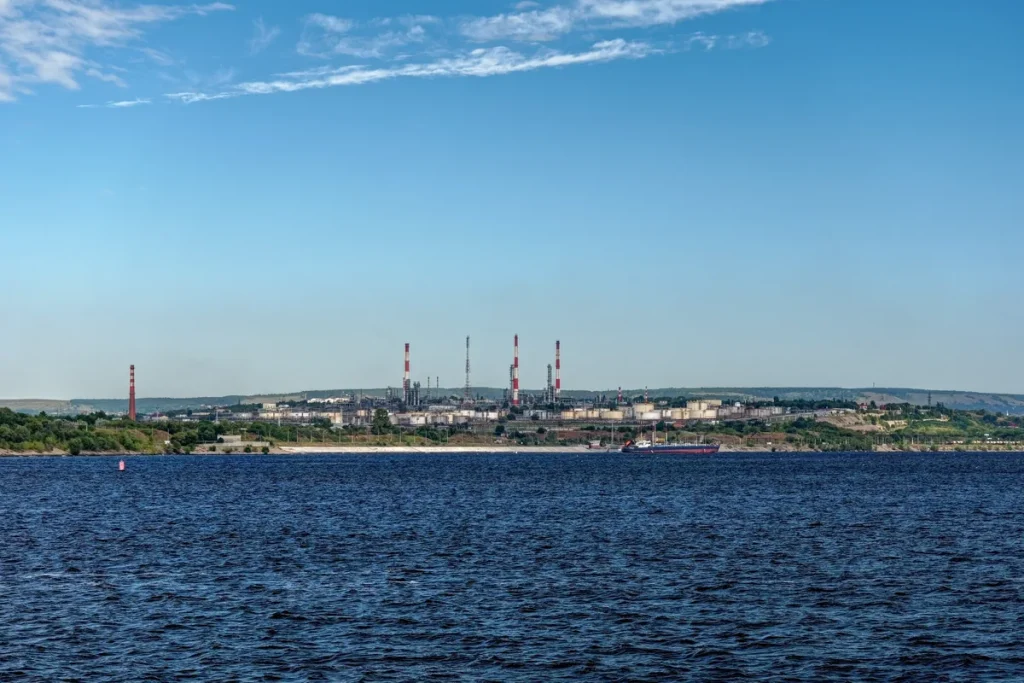
Illustrative only: the Saratov oil refinery seen across the Volga River in Russia in August 2017. It has no link to the diesel arrangement reported here.

